Why chassis are
- Run web apps locally
- Share your apps
- Share their data
- Users store copies of whatever they do
- Shared trustlessly with any requester
- Discovered for locality of interest
- Users of the same app
- Apps on the same list
- User resources store and serve it
What chassis is
chassis run on iroh
chassis is a peer-to-peer application runtime: every app it serves is a local-first document, synced directly between the machines running it, with no central database and no app server you have to trust with your data. Each chassis is a full peer in that network rather than a client of some backend: it authors, stores, and serves its own replicas itself.
Under the hood, chassis is a thin layer over a small set of well-chosen primitives, each doing one job:
Every write in chassis is gated the same way: a NamespaceSecret, or a read-only ticket derived from it, is the only credential that matters. There's no separate ACL system checking who's allowed to do what; holding the right ticket is itself the authorization. That also means a write ticket can't be revoked once a replica has it, only made moot by rotating to a brand-new namespace that the compromised ticket has no claim on.
Everything chassis does, whether publishing an app, sharing a document, or running a chat, is this same small stack, composed differently. The trick that makes that possible is that iroh-docs is used recursively: a document doesn't just hold data, it can hold pointers, in the form of a namespace and a ticket, to other documents. The app registry is itself an iroh-docs document, and each of its entries is a pointer to the document that is that app. A chat app's document holds no messages of its own; it holds just pointers to one document per topic, each a document in its own right, with its own ticket. Giving a new app its own chat channel doesn't mean new infrastructure; it means writing one more pointer into one more document. There is no special-cased registry service, directory server, or index anywhere in chassis; directories are just documents whose entries are addresses of other documents, so the same fine-grained, ticket-based access control that governs one piece of data governs collections of it, for free, all the way down.
How chassis fit together
Three chassis instances. No node in the middle has special authority, including the one that happens to answer a fetch.
to your browser
to your browser
name to namespace
iroh-gossip
(presence/discovery)
name to namespace
capability-gated writes
capability ticket
is the only key
capability-gated writes
hash to bytes
fetch by hash,
verify locally
hash to bytes
sync
Quick start
- Apple silicon users can mail anybody@chassis.engineering to request repo access and an installer.
2. Once it's running, open http://localhost:4919 in your browser.
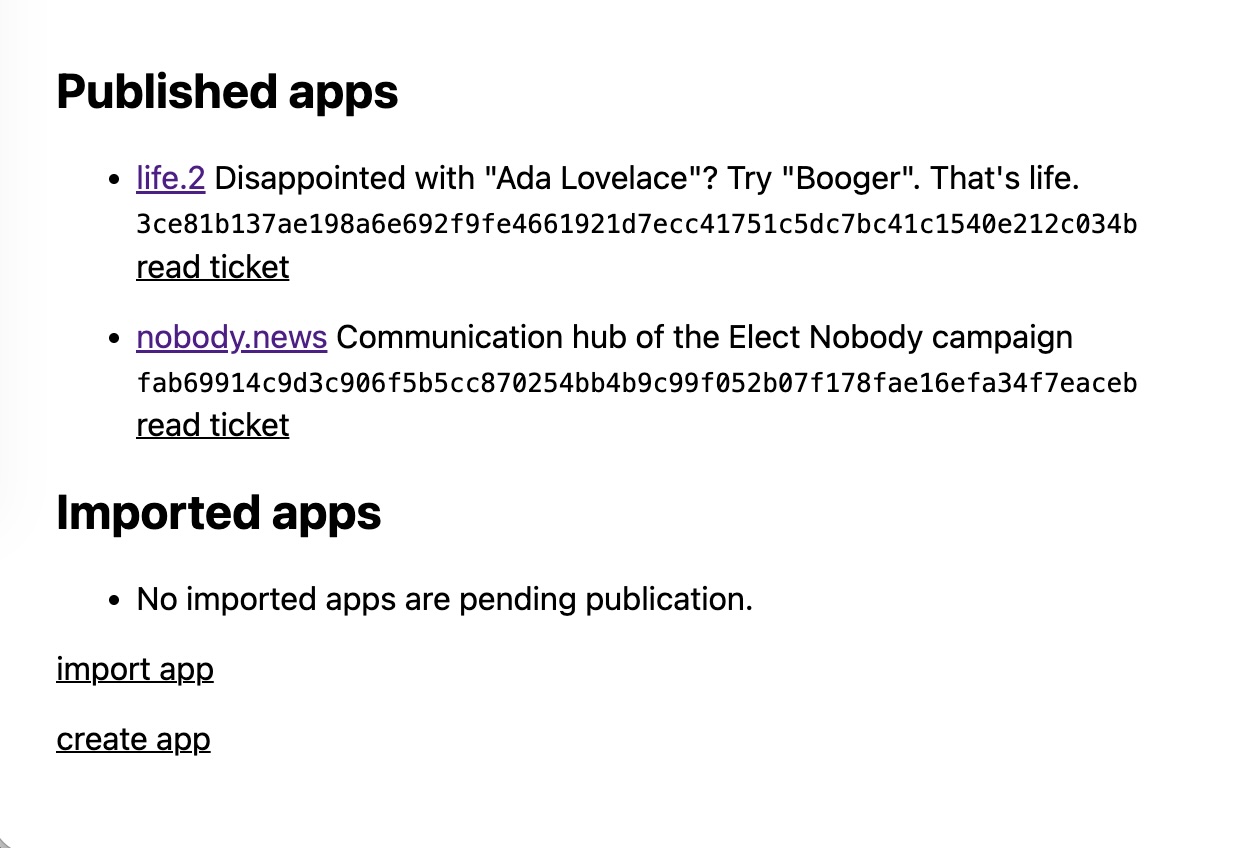
The first page is your chassis's own home: not an app, just the chassis itself telling you what it already knows.
- Published apps lists every app currently published on your little network. Apps you've published yourself show a "Delete" button, which demotes the app back to your own imported apps list, not erasing it.
- Imported apps holds apps you've pulled in by ticket but haven't published yet, each with "Read ticket" and "Write ticket" buttons you can hand to someone else so their chassis can find and sync yours.
- "Import app" lets you paste someone else's ticket to start syncing their app.
- "Create app" starts an AI-guided chat that builds you a brand-new app from a description, the same way this page itself came to exist.
On relays
About 90% of traffic running over Iroh runs directly between peers. The rest runs over stateless relay servers that assist direct link setup by sharing NAT traversal information between peers dialing each other. Relay servers also permit peers to move from their known ip addresses and still be dialed by their endpoint id.